
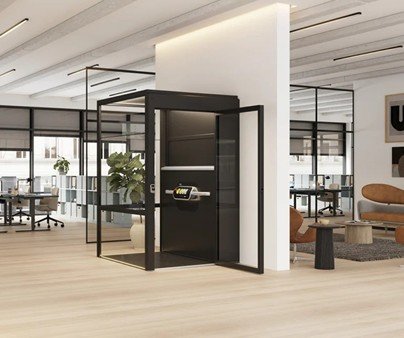
Commercial lifts transport people and help your building run efficiently and stay accessible. You can customise them to fit your layout and look, but what matters most is choosing one that meets safety standards and suits your building’s day-to-day needs. At Lift Experts, we guide you through this process by presenting independent lift options from trusted manufacturers. We start with a detailed needs analysis so that we can recommend a tailored solution that accounts for the space available in your building layout as well as any custom features you require.
While we work closely with you throughout the selection process, you’ll also need to be aware of the safety standards that apply to commercial elevators. When your lift meets recognised standards and supports the right load capacity, you protect your business and create a safer environment for everyone.
What makes a commercial lift code-compliant?
Commercial lifts are only considered to be compliant when they satisfy established safety and accessibility standards.
AS1735.12
AS1735.12 is the standard that focuses on your lift’s accessibility and inclusive design. It sets clear requirements for car dimensions and interior features that support people with disabilities. Many reputable manufacturers offer commercial lift models that meet this standard.
Under AS1735.12, your commercial lift must include:
- Minimum car dimensions and door opening widths
- A curtain of light to prevent doors from closing unexpectedly
- Clear guidelines on wheelchair manoeuvrability, including when a wheelchair can or cannot turn within the car
- An in-car voice announcer to support visually impaired users
- Carefully positioned and easy-to-use signals and controls
- A handrail positioned near the car’s operating panel
EN81-20
EN81-20 is a newer European safety standard; it was introduced by the European Committee for Standardisation to replace the earlier EN81-1. While Australia doesn’t require it, using EN81-20-compliant lifts helps you meet higher safety benchmarks and keeps your building in line with global best practices.
What is the load capacity for commercial elevators?
Load capacity defines how much weight your commercial lift can safely carry, including passengers or goods. This includes the maximum load, which refers to the absolute upper limit, intended only for rare situations. Running a lift at this level regularly would result in an uncomfortable experience.
As a general guideline, you should allow around 1.5 square feet of space per person to determine your lift’s maximum passenger load.
That said, the actual load capacity depends on the type of lift you get and the manufacturer. Standard hydraulic or traction lifts usually handle 180 kg to 4,000 kg and go up to 1.6 m/s. If you need more, machine room-less traction lifts can go beyond 4,000 kg, and overhead traction lifts support even faster speeds and broader design needs.
What other standards does your commercial lift need to fulfil?
Beyond general mobility and safety expectations, make sure your commercial lifts in Australia also align with Disability Discrimination Act (DDA) requirements, which are designed to make sure that people with limited mobility can use the lift safely and independently.
To meet DDA expectations, your commercial lift should comply with AS1735.12 and include:
- Control buttons are positioned within easy reach for users with limited mobility or those using wheelchairs
- Braille markings on push buttons and operating instructions
- A reliable system for emergency calls
- Secure handrails inside the lift car
- Clear voice announcements for floors and travel direction
- Visual indicators that show floor level and lift movement
- Sufficient internal space for a wheelchair to fit comfortably alongside other passengers
We will help you choose the best commercial elevators
Get a quick estimate or request a callback so we can give you a shortlist of the best options for your commercial building. At Lift Experts, our goal is to help you compare options and choose the right commercial lift for your building.